Hardware
Custom hardware, designed and built in house. From schematic to a box of working units.
Hardware experiences
We design and build custom hardware for events and companies: interactive badges, games, challenges and objects people wear and take home. Hardware that makes an event stand out, without a disproportionate budget.
Design, firmware and manufacturing in house. We put together whatever team each project needs.
Case: RootedCON 2026 PACMAN badges
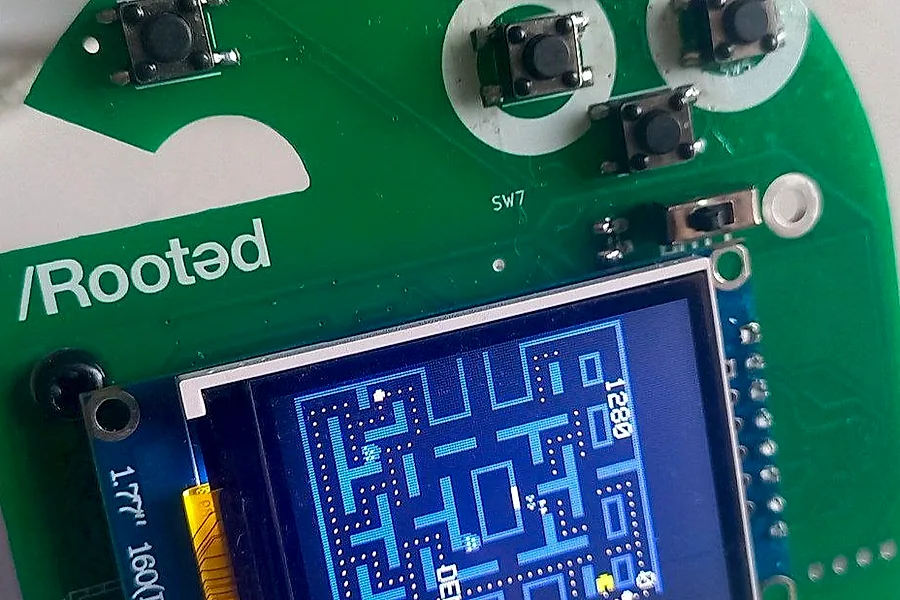
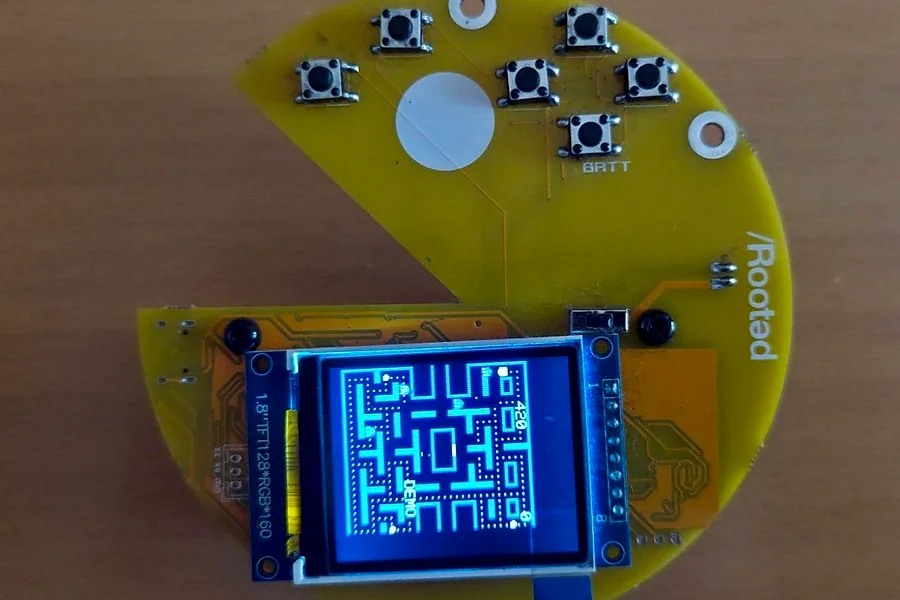
A technical trivia game where the playing field was not just the questions: it was the hardware attendees wore around their necks. Ghost-shaped badges in four colours, with the RootedCON padlock built into the design; the PACMAN ones went to the organisers.

- Platform
- ESP32-WROOM-32 on our own PCB design.
- Comms
- ESP-NOW point to point with the game servers. Questions broadcast, answers sent straight back.
- Display
- 1.8" SPI TFT, with the game running on the badge itself.
- Power
- 1S LiPo with integrated charger and UVLO protection against deep discharge.
- Flashing
- Over USB with automatic RESET and EN control: plug in, run esptool, done — no buttons.
- Debug
- UART0 on the same USB connector (TX GPIO1 · RX GPIO3), exposed on purpose.
- Identity
- Per-badge nickname and unique cryptographic key, stored in the ESP32 NVS.
- Demand
- The previous edition sold out within hours.
Cryptography and challenge design
- Every question is signed with an Ed25519 private key that never leaves the backend. The badge only displays it if the signature validates; no valid signature, no output. In a room full of people running Wireshark, that stops anyone injecting fake questions into everyone else's hardware.
- Every answer is signed with the device's own private key. The backend knows each ghost's public key and checks the answer is authentic, not forged or replayed from another badge.
- The private keys were extractable on purpose: with esptool and some firmware analysis, anyone could dump their badge's memory and recover theirs. It did not break the CTF — signing as yourself gains you nothing, and impersonating someone else needs physical access to their badge — but it made for a genuine hardware hacking exercise.
- Easter egg: a MOSFET on GPIO21 cuts the display ground from firmware, cutting consumption sharply when there are no questions and no interaction. Anyone who spotted it in the schematic got a bonus.
Custom systems
Custom system development, from prototype to a working MVP. Example: an NFC-based management MVP for the leisure sector.
Scope
- Design
- Schematic, PCB, enclosure
- Firmware
- Embedded firmware and the tooling around it
- Manufacturing
- Prototypes and short production runs
Got a hardware project? [email protected]